Victorian wedding ceremony used to be planned and usually not so ostentatious. However, the wedding was the most important day for a Victorian lady or a man. The wedding ceremony took place either at the bride’s home or in the church.
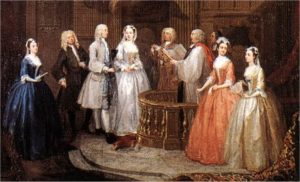
The number of guests was always the personal or mutual choice of the bride, the groom and the family.
The Wedding Ceremony – Before and during the Victorian Era
Before the 1880s the time of the marriage used to be in the morning and the ceremony was required by the law. By the late 1880s, the wedding time was allowed to be extended up to 3:00 PM. Bride’s parish was used and the clergyman, as well as the parish clerk, had to be present in the ceremony.
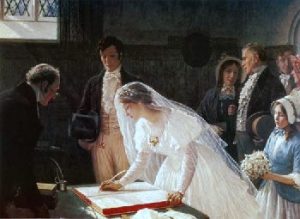
After the ceremony, the newly married couple had to sign their names in the parish register in the vestry. The bride usually signed her maiden name. The church was decorated with flowers and with time and as decades passed, decorations became more elaborate.
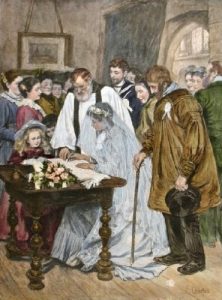
One usher was in charge of the things needed in the church while the others went to the bride’s house for favors which were white ribbons, flowers, lace and silver leaves pinned to their shoulders.
In early Victorian times, favors were pinned on the shoulders of the guests by bridesmaids when they left the ceremony. Later, even the servants and horses used to wear flowers. The servants who were in the bride’s house since her childhood used to receive favors which were handmade by the bride and usually included a special memento.
Victorian Wedding Ceremony
The guests used to arrive at the church in the morning. The bride and her people used to walk to church on a carpet of blossoms because it was believed that this ensured a happy path to life for the bride.
Those who were wealthy had a grey horse pull the wedding carriage for good luck. To make the people aware of the ceremony, church bells were pulled when the bride arrived. It was also done to scare away any evil forces if it were nearby.
The wedding ring usually had the initials of the bride and the groom along with the date of the wedding which was engraved inside. During the Victorian era, some couples followed the double ring ceremony because it was believed that if the ring dropped during the ceremony, it was good luck for the couple.
When the wedding ceremony was over, the bride and the groom left the church seeing to their left and right. Nuts were thrown as a symbol of fertility after the departing couple. The bride’s parents were the first to leave the church and the best man left the church last only after paying the clergymen for his services.
Victorian Wedding Decor
If the celebration was held at home, adorning doorways, fireplaces, windows, and balustrades were decorated. The form and ceremony of the wedding used to vary as per the likings of the bride, groom and both the families.
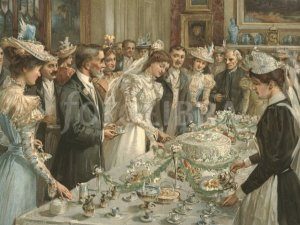
After the marriage ceremony was over, the bride and the groom used to go to home or depot on the special carriage decorated for them. Sometimes a breakfast or supper followed the ceremony and the bride then changed her traveling apparel.
More Info On- Wedding Lore Superstition, Wedding Preparation, Victorian Wedding Attire