The Chartist movement was essentially an economic movement with a purely political programme.
Chartist movement definition
Chartism was a working-class movement for political reform in Britain which existed from 1838 to 1857.
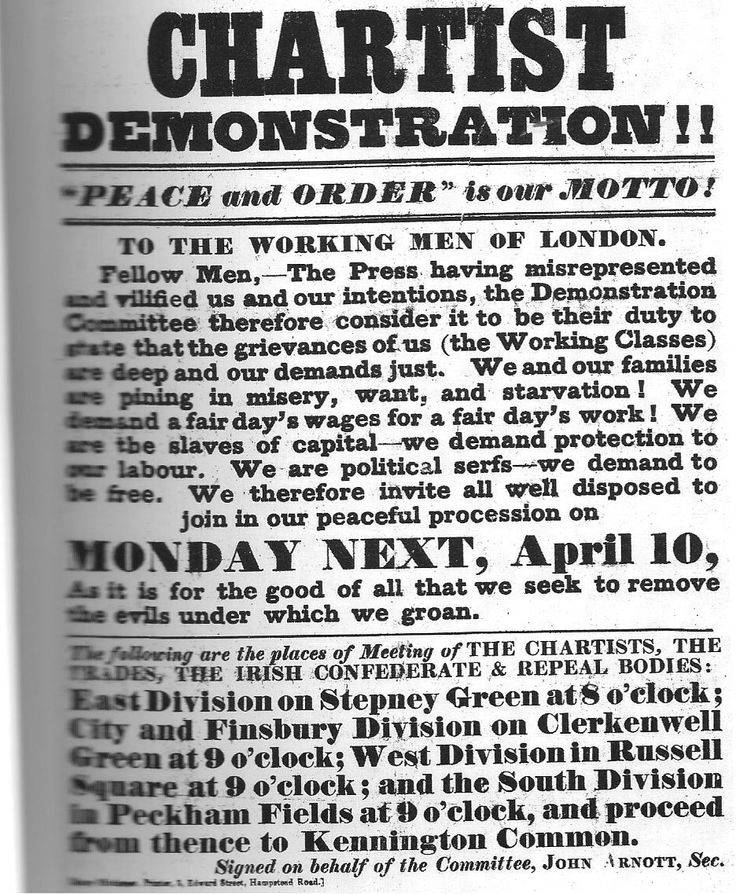
The period from 1830 to 1850 witnessed radical political and economic changes. Industry flourished while agriculture declined. There was a conflict between old-fashioned fears and modern outlooks. The people’s charter of 1838 was the very basis of the Chartist movement, a product of industrialisation and lack of economic and social security.
It was drafted by William Lovett for the London Working Men’s Association. Chartist movement was a radical campaign for parliamentary reform. It was a working men’s movement to achieve parliamentary democracy in order to achieve social and economic reform.
Chartist movement summary of demands
The first Chartist meeting took place in 1839 at London. This convention adopted the motto, peaceably if we may, forcibly if we must. The Charter made six important demands. Here is the summary:
- To hold general elections annually.
- To pay salaries to MPs.
- To remove the requirement of ownership of property to the members of Parliament.
- To introduce a secret ballot system.
- To establish electoral districts of equal size.
- To establish universal adult suffrage.
The outcome of the movement was that the chartists collected over 1.25 million signatures and submitted to the House of Commons in 1839. But the charter was rejected by the parliament by a vote of 235 to 46. Subsequently, there was an outbreak of violence throughout the city and many leaders were arrested.
The demonstrators marched to the prison at Newport, Monmouthshire demanding the release of their leaders. The troops opened fire in which 24 were killed and 40 were wounded. The criticism against Chartist movement is that they were utopian in their belief that economic and social betterment directly follows from constitutional reform. There are many reasons for the failure of Chartist movement: It failed to gather support in Parliament.
It failed to gather support from the middle classes.
It was radical and utopian in nature.
It failed to sustain itself when there emerged many social reform movements.
However, some others opine that it was not a failure, but a success because the many of the grievances of the chartist movement were answered in the electoral reform bills of 1864 and 1867.