|
Fashion of Victorian Era comprises the various fashions and trends in British culture that emerged and grew in province throughout the reign of Queen Victoria, a period which lasted from June 1837 to January 1901.
The introduction of the lock-stitch sewing machine in mid-century simplified dressmaking, for both homes and boutiques, and enabled for lavish application of trim that would have been prohibitively time-consuming if done by hand. Lace machinery made lace very cheap and easily available. New materials from far-flung British colonies gave rise to new types of clothing.

Womens Apparel
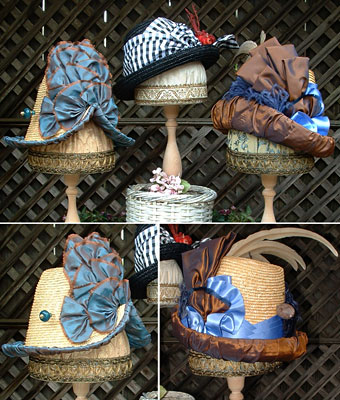
The dresses of the early Victorian era were similar to that of the Georgian age. Basic apparel for a woman consisted of a dress, with a top hat or bonnet.
In the middle 1840s, corsets, a knee-length chemise, and layers of flounced petticoats were worn under the gowns. The chemise and petticoats were replaced by pantalettes and the crinoline as the size of the skirts expanded. The use of crinoline thrived, and expanded during the 1850s. In the 1860s, the skirts became flatter at the front and projected out more behind the woman. In the 1870s, un-corseted tea gowns were first introduced for informal entertaining at home and steadily grew in popularity. Bustles were used to replace the crinoline to hold the skirts up behind the woman.

By 1880s, the use of bustles had declined. Outdoor clothing became popular. Riding clothes had a matching jacket and skirt (without a bustle), a high-collared shirt or chemisette, and a top hat with a veil while hunting costumes had draped ankle-length skirts worn with boots or gaiters. Clothes worn when out walking had a long jacket and skirt (with the bustle) and a small hat or bonnet.

In the 1890s, women's fashion became simpler and less extravagant; bustles fell out of use and dresses were not as tight as before. Corsets were still used but became slightly longer, giving women a slight S-curve silhouette. Skirts fitted closely over the hip with a wasp-waist cut and flared just above the knee. High necks and puffed sleeves became popular. Sportswear for women, such as bicycling dresses, tennis dresses, and swimwear became popular.
Mens Apparel
For men, the basic clothing consisted of shirts, trousers, coats, neck ties known as cravats and hats.
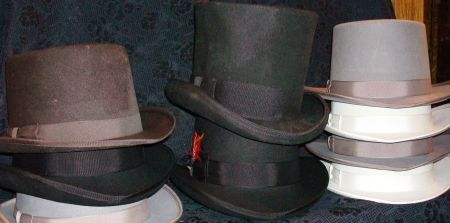
During the 1840s, men wore tight-fitting, calf length frock coats and a waistcoat or vest. The shirts were made of linen or cotton with low turned down collars and worn with wide cravats. Trousers had front fly, and breeches were used for formal functions and when horseback riding. Men wore top hats, with wide brims. By the 1850s, men started wearing shirts with high upstanding or turnover collars and four-in-hand neckties tied in a bow (a knot with the pointed ends sticking out like "wings"). The upper-class continued to wear top hats, but the working class preferred the bowler hats.
In the 1860s, men started wearing wider neckties that were tied in a bow or looped into a loose knot and fastened with a stickpin. Frock coats were shortened to knee-length and were worn for business, while the mid-thigh length sack coat slowly displaced the frock coat for less-formal occasions. Top hats became the very tall "stovepipe" shape, but a variety of other hat shapes were also popular.
During the 1870s, three-piece suits grew in popularity along with patterned fabrics for shirts. The Ascot ties began to grow in popularity. A narrow ribbon tie was an alternative for tropical climates, especially in the Americas. Both frock coats and sack coats became shorter.
During the 1880s, dark tail coat and trousers with a dark waistcoat, a white bow tie, and a shirt with a winged collar were introduced as formal evening wear. In mid-decade, the dinner jacket or tuxedo was used in more relaxed formal occasions. The Norfolk jacket and tweed or woolen breeches were used for rugged outdoor pursuits such as shooting and hunting. Knee-length topcoats, often with contrasting velvet or fur collars, and calf-length overcoats were worn in winter. Men's shoes had higher heels and a narrow toe. During the 1890s, the blazer was introduced, and was worn for sports, sailing, and other casual activities.
Throughout the century, it was stylish for men to wear facial hair. Hair was generally worn short. The clean shaven look of the Regency was out, and mustaches, mutton-chop sideburns, Piccadilly Weepers, full beards, and Van Dykes (worn by Napoleon III) were the order of the day.
|